Sara
Dark Lies the IslandSara’s episode turns a year out at a remote holiday home into an intimate account of psychological crisis and a tentative, hard-won pause. After months of poor sleep and concealed self-harm, she moves between the fast, impersonal rhythms of an online forum and a house filled with reminders of her family. A frightening encounter in the dark and the discovery of the knives left within reach bring the crisis to a decisive point: she removes the knives from the house, then sits alone above Clew Bay and experiences something briefly like sleep.
Identity and Background
Sara has completed her Leaving Certificate, with results in August that qualify her for either Medicine or Veterinary studies. The range of futures apparently open to her contrasts with her difficulty sleeping and the private injuries she carries. Scarring on her wrists and thighs, along with the remains of a smiley she carved on her ankle, indicate a history of self-harm; the passage does not explain its beginnings or reduce her circumstances to a single cause.
She is staying alone at a family summer house during a year out, a choice she presents to her father as time for art. He questions what she will do there as winter approaches, while she asks him for the keys and alarm code. His unspoken appeal that she not harm herself is set against her brief, practical explanation, establishing a gap between the danger he recognizes and what she is willing to discuss with him.
Isolation and Daily Routine
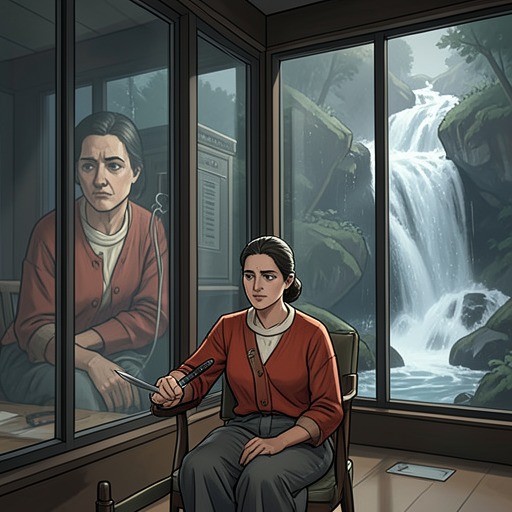
The house is remote and architecturally distinctive: her father, a radical architect who rethought the idea of walls, designed it as a glass-and-angles structure with austere views over the bog. A stream runs through the open-plan space beneath a thick glass floor. The setting makes solitude unusually exposed; the house is open to its landscape even as Sara remains alone within it.
With only slow dial-up internet at home, Sara goes daily to a cineplex at the edge of town to use coin-operated terminals in an upstairs lobby annexe. There she moves between windows on 4-Real Forum, while the noise from the cinema below and the speed of her own thoughts form a disorienting background. On this evening she begins a post with the hesitant phrase “Maybe tonite …” and sees Gretchen from Flagstaff online. When the terminal warns that sixty seconds remain, Sara does not insert another coin. Instead, she leaves quickly, crosses the car park to Apache Pizza, eats a twelve-inch four-cheese pizza, and drives back to the holiday home in her old, wine-coloured Saab.
Her perception repeatedly seems to outrun ordinary time: while driving, she imagines seeing herself from outside, as though filmed. This distance from her own actions accompanies a mind moving so quickly that, as the narrative puts it, she is losing weight. At home, the daily presence of her father’s knives takes on new significance: he had conspicuously left every blade in place when he first brought her out, and the Sabatier knives remain on their block.
Family Relationships and Unspoken Distress
Sara’s father is away in Granada and phones nightly, maintaining a breezy manner that she experiences as inadequate to the seriousness of her condition. When he asks how long matters will go on and says he knows she has been going through a hard time, she answers that he does not know. The exchange marks not an absence of contact but the limits of what their contact can accomplish: he reaches toward her through reassurance and remote attention, while she rejects the idea that he understands her experience.
Her relationship with her mother is also unsettled. When her mother calls their complexions delicate, Sara reacts inwardly to the word “We!”; the pronoun seems to impose a shared family identity where Sara feels a distance. Later, after switching off the phone, she imagines her father composing a message from Granada while sipping Fino and thinking of himself as unlike other fathers. The imagined scene conveys her resentment and skepticism, but it does not establish what her father actually thinks.
Sara’s own brief explanation of her plans—as “art stuff”—sits uneasily beside her father’s suggestion that she should give her condition expression. When she eventually answers a call by saying that she has a meringue cake nearly done and must run, the ordinary domestic pretext avoids the conversation her father is trying to have. The scene’s details show a relationship sustained by calls and messages but strained by the difference between his attempts to interpret her and her refusal to feel understood.
Crisis at the House
After returning, Sara turns on the lamps and later moves between the lit interior and the night outside. Her distress takes the form of an encounter she experiences as a waking nightmare: she feels seized and unable to call out, then breaks free and runs indoors. From there, she sees faces crowding the windows before they disappear. The narrative gives this experience through Sara’s perception and does not offer an independent explanation of what she sees.
The episode is followed by another text from Granada, urging her to give her experience expression. Sara switches the phone back on, imagines her father’s circumstances as she reads the message, and responds inwardly with anger. The knives remain a separate, concrete presence in the house. Sara takes them outside and throws them one by one into the dark boggy ground, including a serrated breadknife. The action changes the immediate conditions around her: the knives are no longer on the kitchen block, but the passage does not present it as a cure or as proof that her distress has ended.
A Brief Interval of Calm
After disposing of the knives, Sara wraps herself in her father’s mustard-coloured duffel coat and goes outside again, barefoot. From a high vantage point she looks over Clew Bay and its small islands. A break in the cloud briefly lets moonlight pick out one low island; the moment gives the landscape a quiet, temporary clarity after the preceding disturbance.
She sits on the wet ground, closes her eyes, and holds her knees. The narration describes her withdrawing from the world for a short while: first half a minute, then a whole minute, and finally something a little like sleep. The ending is deliberately modest. Sara has not resolved the conflict with her parents or explained what she has experienced, but she has removed the knives from her immediate surroundings and reached a brief pause in which rest seems possible.
Narrative Perspective and Significance
The episode stays close to Sara’s perceptions, shifting from the practical sequence of terminals, food, and driving to her racing thoughts, imagined scenes, and frightening vision at the windows. This movement makes the ordinary and the destabilizing coexist without turning the vision into an externally verified event. The reader encounters the crisis through the disjunction between what Sara does in public, what she withholds from her parents, and what she experiences alone.
Concrete thresholds organize the episode: the countdown on the terminal, the drive back to the house, the glass between the open-plan interior and the stream, and the doors between lit rooms and the night. Sara repeatedly crosses them, but the final movement outside is different from her earlier flight. Sitting above the bay, she is not presented as cured or reconciled; she is momentarily able to remain still. The episode’s significance lies in that limited change, and in the contrast between the abundant choices suggested by her exam results and the immediate, practical measures through which she tries to endure the night.